Re-Imagining Governance in the Age of the Fourth Industrial Revolution
Authors: Dr. Chang-Hak Choi, Professor Dr. Subarna Shakya, Dear Dr. Manish Pokharel, Er. Saroj Devokota, Er. Mahesh Singh Kathayat, Dr. Shayan Kirat Rai, Bimal Pratap Shah
About the Book
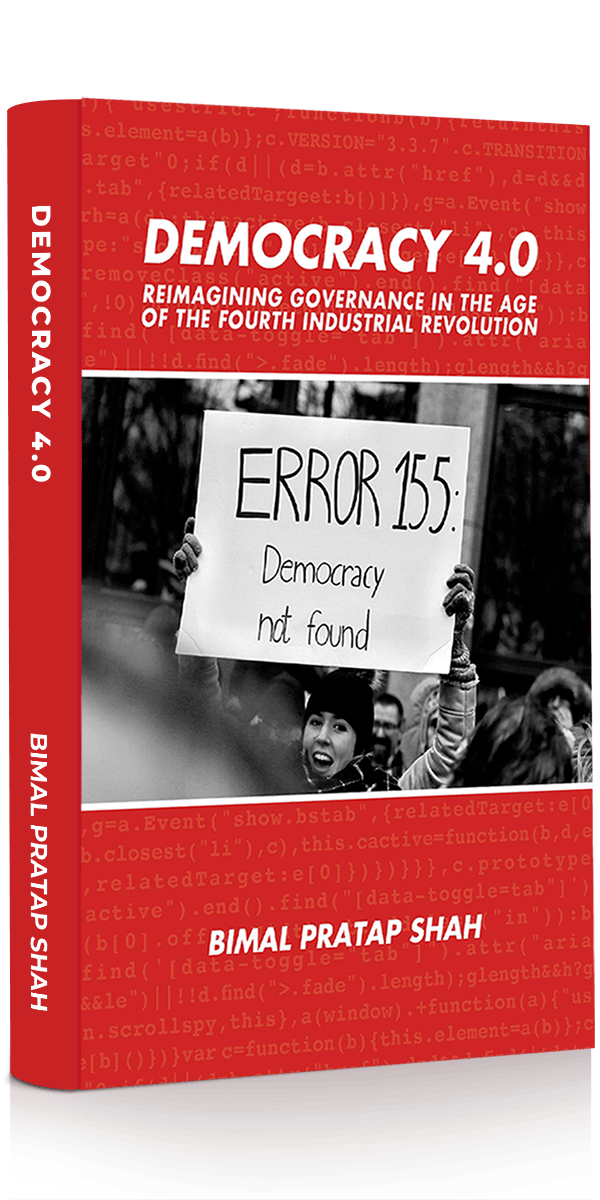
Democracy 4.0
Re-imagining Governance in the Age of the Fourth Industrial Revolution
Klaus Schwab, the visionary founder and Executive Chairman of the World Economic Forum (WEF), set the stage for a technological renaissance with his call to action in 2016 for the Fourth Industrial Revolution (4IR). His sharp insight illuminated the profound impact that rapidly advancing technologies like artificial intelligence (AI), robotics, big data, and the Internet of Things (IoT) would have on society, politics, and the economy.
For developing countries, the Fourth Industrial Revolution represents a unique opportunity to catch up with their developed counterparts who had a head start in the first three industrial revolutions. However, this opportunity can only be fully leveraged with the cooperation of academia, industry, and the public sector to develop effective policies and programs.
In this digital age, constant updates to skills and innovative ideas are essential, making it crucial for our education and training systems to adapt. To remain competitive in the changing digital landscape, individuals must possess the critical thinking and flexible skills needed to succeed in the workplace of the future.
The Fourth Industrial Revolution offers unparalleled benefits, but realizing these benefits requires leadership with the skills to navigate digital disruptions. Sadly, many government leaders are ill-prepared to drive change and spur the next wave of economic growth.
The book, "Democracy 4.0," offers a concise guide for policymakers and government officials who must prepare their organizations for the impending transformation. The collection of essays draws on extensive research, real-world implementation experiences, and international best practices to present a range of policy options and arguments for a specific course of action.
Featuring contributions from distinguished senior government leaders and scholars, the recommendations are based on over two decades of impactful work from the author, co-authors, and governments worldwide. "Democracy 4.0" serves as a rallying cry for all those who aspire to seize the immense opportunities of the Fourth Industrial Revolution and create a better future for all.
There is little disagreement today among mainstream economists on the indispensability of sustained economic growth for reducing human deprivation. Although there is no consensus on how to achieve growth on a sustained basis, the contours of a new paradigm have emerged after distilling the diverse development experiences in the 20th century. First, fast-growing economies are oriented towards greater participation in international trade and investment. Second, the quality of institutions at home – rule of law, contract enforcement, control of corruption, mechanisms to resolve conflicts, prudent regulations – underpins development in the long run. Third, infrastructure in terms of software (people's skills) and hardware (roads, ports, energy) is vital. I believe that the emerging digital tools have the potential to accentuate and augment all these potentials for greater human progress.
Over the past two decades, governments have begun to upgrade digitally so that citizens are able to engage with them, and with each other, through the Internet. They have embraced digital transformation as a strategy for improving governance, operational efficiency, and service delivery. Paradoxically, Nepal has lagged and leapfrogged at the same time. While we have grown our network of telephone connectivity from a mere 72,000 units to over 30 million cellphone subscriptions over the 25 years between 1992 and 2017, for example, the quality of the digital ecosystem remains nascent. Given the country's landlocked status, digitalization has to be at the heart of our strategy to negate handicaps associated with geographical adversity.
The coming decades will be about the Fourth Industrial Revolution characterized by big data, autonomous machines and robotics, artificial intelligence, and the Internet of Things. It is, therefore, necessary for the government and private firms to adopt integrated digital and physical technologies to leverage new inventions for greater productivity, growth, and job creation.
Bimal Pratap Shah has consulted for the Government of Nepal since 2003. This broad experience has given him insights into the challenges faced by developing countries when seeking to transform digitally. This book weaves together the passions, experience, knowledge and advice of Shah and his notable co-authors.
I am confident that this compendium will be a useful resource for everyone concerned about the opportunities and threats posed by the new digital landscape, from cyber-security and internet addiction to the promise of a digital economy undergirded not just by artificial intelligence and e-commerce, but also e-participation of citizens so that we build a cleaner, more effective and meaningful democracy in the digital era.
Swarnim Waglé
Elected Member
Federal Parliament
Nepal
Former Vice-Chair
National Planning Commission
Government of Nepal https://swarnimwagle.com.np Rockstar EconomistEnthralling Episode in Sustainable Development
At the gracious invitation of Dr. Swarnim Wagle, a prominent member of the National Planning Commission (NPC) at the time, Nepal had the privilege of hosting Professor Jeffrey D. Sachs in 2016.
Sachs serves as the Director of the Center for Sustainable Development at Columbia University, where he holds the rank of University Professor, the university's highest academic rank. Sachs was Director of the Earth Institute at Columbia University from 2002 to 2016. He is President of the UN Sustainable Development Solutions Network, Co-Chair of the Council of Engineers for the Energy Transition, Commissioner of the UN Broadband Commission for Development, Tan Sri Jeffrey Cheah Honorary Distinguished Professor at Sunway University, and SDG Advocate for UN Secretary General António Guterres. From 2001-18, Sachs served as Special Advisor to UN Secretaries-General Kofi Annan (2001-7), Ban Ki-moon (2008-16), and António Guterres (2017-18).
Delve into this highly insightful and captivating public lecture by Professor Sachs on 'Sustainable Development in an Uncertain World' to glean valuable insights into why climate change cannot be ignored and why we cannot disregard the profound changes brought about by the scale, scope, and complexity of the technological revolution. This enlightening discussion is expertly moderated by Dr. Swarnim Wagle.
Advisory Committee, Seoul Digital Foundation, South Korea
Dr. Chang-hak Choi is the Chairman of the Advisory Committee at Seoul Digital Foundation in South Korea, and he previously served as the President of LX, a public organization that has been contributing to the protection of property rights for the Korean people and the development of the national cadastral system. Since its establishment in 1977, it has offered fast and accurate survey services and various cadastral spatial data.
Dr. Choi's leadership experience in the digital industry is unparalleled, having served as the President of the Digital Industry Promotion Agency, SIRI (Spatial Information Research Center), KCISA (Korea Culture Information Service Agency), and CEO of eGOV Consulting Co. Ltd. He is widely recognized for his five-year tenure as the Director-General of E-government at the Presidential Committee on Government Innovation and Decentralization, where he made a lasting impact in the country.
Dr. Choi's expertise in e-government extends beyond Korea's borders, as he has served as an advisor for governments in countries such as Nepal, Colombia, Vietnam, Egypt, Kyrgyzstan, Paraguay, the Philippines, and Nigeria. He has also made invaluable contributions to academic communities, serving as a lecturer at several universities including Yonsei University, Hanyang University, Ewha Women University, Sung Kun Kwan University, and Daegu University.
Dr. Choi's contributions have been widely recognized with numerous accolades, including a Certificate of Commendation from President Kim Dae Jung in 2003 and the Medal of Honor from President Roh Moo Hyun in 2007. These achievements serve as testament to Dr. Choi's visionary leadership and exceptional service to the people of Korea and the world.
Professor Saroj Devkota
Former Vice Chairman
High-Level Commission for Information Technology, Goverment of Nepal
Late Professor Saroj Devkota was a respected leader in the field of education and technology in Nepal. He served as the Vice-Chairman of the High-Level Commission for Information Technology, which was chaired by the Prime Minister, and as the Executive Chairman of Silk Road International College. He was also a National Evaluation Expert for the TASS project under the Ministry of Foreign Affairs.
He held a Master of Science in Education Management from North East London University in the UK and a Bachelor of Science from the Civil Aviation Institute in Ukraine. He brought a wealth of experience to his roles, having served as an advisor to the National Vocational Qualification System project and as a Senior TVET Policy Dialogue Consultant for UNDP's Skills Project.
In addition to his positions of leadership, he was a highly respected member of several organizations, including the Nepal Engineers Association, the Nepal Academy of Science and Technology, and the Nepal Engineering Council. He held various positions such as Head of Department at the Institute of Engineering (Tribhuvan University), Chief of the Center for Instructional Material Development Unit, and Assistant Dean of the Institute of Engineering. He was also the Vice Chairman of the Council for Technical Education and Vocational Training (CTEVT) and a Task Force Member of the National Education Commission under the Ministry of Education.
His contributions to education and technology were widely recognized, and he was honored with several important positions, including Chairman of the Technical Committee for the Nepal Engineers Association, Chairman of the National Skill Testing Board under the Ministry of Education, and a member of the High-Level National Education Commission. The reverberating echoes of the Late Professor Saroj Devkota's contributions to the fields of education and technology in Nepal still linger in the hallowed halls of academia and government. The indelible mark he left on the development of technology in Nepal is a testament to his unwavering commitment to excellence and innovation. His legacy lives on as an inspiration to future generations of scholars and technologists alike.
Professor Dr. Manish Pokharel
Dean
School of Engineering, Kathmandu University
Professor Dr. Manish Pokharel, a preeminent scholar and leader in the field of engineering, is the proud Dean of the School of Engineering at Kathmandu University in Nepal. With a Ph.D. in E-government from Korea Aerospace University in South Korea and a Master's in Engineering from the renowned Birla Institute of Technology and Science in India, Dr. Pokharel's academic credentials are beyond impressive.
Upon taking the reins as Dean of the School of Engineering at Kathmandu University in Nepal, hel embarked on a mission to transform the field of technology in his home country. With a keen understanding of the growing importance o f Artificial Intelligence (AI), he set out to launch two groundbreaking programs in this cutting-edge field: the Bachelor of Technology in Artificial Intelligence (BTech AI) and Master of Technology in Artificial Intelligence (MTech AI).
These programs represent a significant first for Nepal, marking the country's entry into the rapidly evolving world of AI and providing students with the skills and knowledge they need to compete in a rapidly changing job market. Under Dr. Pokharel's visionary leadership, these programs are poised to have a lasting impact on the future of technology in Nepal and beyond, fostering a new generation of AI experts who are equipped to tackle the challenges of the 21st century.
The esteemed School of Engineering at Kathmandu University (KU) has forged a partnership with the renowned Indian Institute of Technology Madras (IITM) to offer an International Master's Program in Energy Systems. Spearheaded by the esteemed Dean Pokharel, the program is a collaborative effort between various departments of engineering, ranging from aeronautical to metallurgical, and non-engineering departments such as humanities and social sciences. By uniting a diverse range of disciplines, the program aims to cultivate a nuanced understanding of the multifaceted relationship between energy, technology, and society.
Dr. Pokharel's impact extends far beyond the realm of academia. He is a respected leader in his field, playing a pivotal role in shaping the future of technology and governance in Nepal and beyond. As a member of both the High-Level ICT Council, chaired by the Prime Minister of Nepal, and the High-level National Education Council, chaired by the Minister of Education, Science, and Technology, Dr. Pokharel is using his expertise and influence to drive positive change on a national and global scale.
His expertise in e-government has made him a sought-after consultant, with notable projects including the development of e-government master plans for Costa Rica and the Philippines for the National IT Industry Promotion Agency of South Korea, as well as a study on the National Identification System in Nepal for the World Bank's Information and Communication Development Technologies Unit.
And yet, for all his professional achievements, Dr. Pokharel remains a true citizen of the world. His fluency in three languages and his global outlook, shaped by his travels to countries like India, Thailand, Singapore, South Korea, and the United States, make him a uniquely talented and visionary leader, poised to shape the future of engineering and technology for generations to come.
Professor Dr. Subarna Shakya
Director
Information Technology Innovation Center, Institute of Engineering, Tribhuvan University
Professor Dr. Subarna Shakya is a distinguished and eminent scholar who has made significant contributions in the field of information technology. With a wealth of experience and expertise, Dr. Shakya has garnered international recognition and has become a well-known and respected figure in his field. His extensive research, scholarly publications, and innovative approaches have set him apart as a leader and authority in the area of information technology. As a result of his accomplishments, Dr. Shakya has become a prominent and highly-regarded figure in the academic community, and his work has had a profound impact on the field.
As the Director of the Information Technology Innovation Center at Tribhuvan University, and a full-time Professor of Computer Engineering at the Department of Electronics and Computer Engineering at the Institute of Engineering (IOE), he has been at the forefront of shaping the field and inspiring a new generation of technology leaders.
Dr. Shakya holds a Ph.D. in Computer Engineering from Lviv Polytechnic National University in Ukraine, and was a visiting professor at Brown University in the United States. He has received numerous awards for his contributions, including the Young Scientist Award from the Nepal Academy of Science and Technology and the title of "Most Innovative Person in ICT Education" by ICT Frame magazine. He has also been recognized as one of the 100 Most Dedicated Professors by the World Education Congress in 2019.
In addition to his academic achievements, Dr. Shakya has held numerous positions of leadership, serving as the Executive Director at the National Information Technology Center, the Head of the Department of Electronics and Computer Engineering, and the Director of the Center for Information Technology, among others. He is also an Advisor-Member on the National Information Technology Committee of the Government of Nepal and a member of several professional organizations, including the IEEE, the Society of Digital Information and Wireless Communications, and the International Association of Computer Science and Information Technology.
Dr. Shakya's research interests are wide-ranging and include ICTs, e-government systems, information security, multimedia systems, computer simulation and modeling, cloud computing, information systems, computer architecture, and software engineering. He has published over 80 technical and policy-related papers in esteemed national and international journals and has delivered keynote speeches at universities around the world, including Seoul National University, Galgotias University, the University of Engineering and Technology in Pakistan, and several universities in the United States.
Dr. Shakya's contributions to the field of information technology are truly remarkable, and his dedication to advancing the field and inspiring the next generation of technology leaders is inspiring. He stands as a testament to the power of hard work and the impact that one person can have on shaping our digital future.
Dr. Shakya's unwavering commitment to education and innovation has earned him recognition as one of the 100 Most Dedicated Professors by the World Education Congress in 2019 . This accolade serves as testament to his dedication to the field of Information Technology and his impact on the education industry globally.
Books of considerable esteem and scholarly recognition.
Smart Technologies for Sustainable and Resilient Ecosystems 3rd EAI International Conference, Edge-IoT 2022, and 4th EAI International Conference, SmartGov ... Telecommunications.
Sentiment Analysis and Deep Learning: Proceedings of ICSADL 2022 (Advances in Intelligent Systems and Computing Book 1432).
Proceedings of Third International Conference on Sustainable Expert Systems: ICSES 2022 (Lecture Notes in Networks and Systems Book 587).
Mobile Computing and Sustainable Informatics: Proceedings of ICMCSI 2021 (Lecture Notes on Data Engineering and Communications Technologies Book 68).
Image Processing and Capsule Networks: ICIPCN 2020 (Advances in Intelligent Systems and Computing Book 1200).
Proceedings of International Conference on Sustainable Expert Systems: ICSES 2020 (Lecture Notes in Networks and Systems Book 176).
Intelligent Data Communication Technologies and Internet of Things: ICICI 2019 (Lecture Notes on Data Engineering and Communications Technologies Book 38).
Associate-Professor Er. Mahesh Singh Kathayat
Professor/Advisor
Department Of Computer Engineering, Kathmandu Engineering College
Senior Associate Professor Er. Mahesh Singh Kathayat is a seasoned Academic Advisor and Senior Associate-Professor at Kathmandu Engineering College, boasting an impressive academic background. He earned his MSc degree from Tashkent Polytechnic Institute at Tashkent State University in Uzbekistan and went on to receive an MBA from the Ace Institute of Management in Nepal.
With an extensive career in the field of Information and Communication Technology (ICT), his expertise has been sought after both nationally and internationally. As the Deputy Inspector General and Head of the Computer Directorate of Nepal Police, he demonstrated his ability to provide senior-level ICT strategic management, leading the development of several key ICT systems, including a Personnel Record System, a Daily Incident Record System, and a Criminal Record System. He also made significant contributions to expanding the ICT network of Nepal Police, making it the most technologically advanced government agency in the country.
His work with the United Nations Integrated Mission to Timor-Leste Police highlights his commitment to international development. He served twice, first as the head of the UNPOL Database unit and then as the Chief of Staff at the UN UNPOL headquarters in Dili, East Timor. In these roles, he was responsible for the administration and personnel management of over 1,700 UNPOLs and FPUs from 42 different nations.
As the Executive Director of the National Information Technology Center, his impact has been far-reaching, leading important initiatives such as the National Data Center, an e-government master plan, and rural telecenters. He has served as a resource person for various organizations and academic institutions, including Uniglobe College of Management, the Ace Institute of Management, the Nepal Administrative Staff College, and the Institute of Engineering.
He has made substantial contributions to his field through his research, publishing over 52 articles in national and international journals and presenting papers at over 31 national and international conferences and seminars. He is also a published author of both professional books and books on Nepali and Indian subcontinent history.
His achievements and contributions to ICT and development have been recognized through several awards and accolades, including the 1st and 2nd Professional Writer Award from Nepal Police Headquarters and UN Meals, as well as a long service medal from Nepal Police. Currently, he is currently pursuing research in the fields of Vedic philosophy (Metaphysics) and particle physics (quantum mechanics)., demonstrating his dedication to lifelong learning and intellectual growth.
Dr. Shyan Kirat Rai
Deputy Director of Studies
Nepal Administrative Staff College (NASC), Governmennt of Nepal
Dr. Shyan Kirat Rai is a renowned scholar in the field of e-governance and technology for development. As the Deputy Director of Studies at the Nepal Administrative Staff College (NASC), he brings a wealth of expertise to the institution.
Holding a Ph.D. from the Centre for Urban Science and Engineering at the Indian Institute of Technology (IIT) Bombay, Dr. Rai was the recipient of a prestigious scholarship through the DAAD Regional Scholarship Program. His research focused on the development of an advanced e-governance system, specifically in the form of a government-to-government (G2G) framework to improve the allocation of volunteers during natural disasters.
In addition to his role at NASC, Dr. Rai is a sought-after trainer in a variety of areas, including e-government, technology in development, disaster management, public administration, social media for development, knowledge management, and smart city development. He has received specialized training from renowned institutions such as the Asian and Pacific Training Center for Information and Communication Technology for Development, the Asian Institute of Technology (AIT), and the Administrative Staff College in India.
Dr. Rai's impact extends beyond the classroom as he has designed and led training programs for Nepali civil servants on the use of ICT in development, governance, and disaster management, emphasizing the role of technology in promoting socio-economic development. As a vocal advocate for the appropriate utilization of ICT in public administration and other sectors, Dr. Rai is dedicated to advancing Nepal's socio-economic progress through technology.
Bimal Pratap Shah
Primary Scribe
Bimal Pratap Shah is a true polymath of the digital age, bringing expertise and experience to a wide range of fields and initiatives in the realm of e-governance. He holds a Master of Science in Informatics from the Swedish Business School at Orebro University in Sweden, which he pursued with a prestigious scholarship from the Swedish Institute. He was selected as a distinguished Government Fellow in the inaugural batch at the Center for Electronic Governance hosted by the United Nations University-International Institute for Software Technology (UNU-IIST).
His work stands as a testament to his unrelenting commitment to leveraging the full potential of technology to drive positive change in society. With a remarkable set of skills and accomplishments to his name, he is a force to be reckoned with in the world of tech, serving as a model of unwavering passion and determination for others in the field. His boundless creativity and groundbreaking innovations have made a lasting impact on the industry, cementing his place as one of the foremost pioneers of the digital age.
In 1993, when the internet was still in its embryonic stage and most people had yet to fathom its vast potential, he was part of a small group of forward-thinking individuals in the US who recognized its immense value for commerce. His acute intuition led him to perceive that Usenet, often regarded as a mere conduit for sharing messages and ideas, could be utilized as a vibrant marketplace where buyers and sellers could seamlessly engage in transactions without the traditional limitations of commerce. He beheld the epiphany and seized the opportunity with gusto, peddling bootlegs cassette tapes of Metallica's live performances on the very platform, harnessing its fluid infrastructure to extend his commercial realm and broaden his horizons.
In the book, Bimal not only expertly recounts the story of pre-World Wide Web, pre-Amazon, and pre-eBay e-commerce before Pulp Fiction shifted the cinematic landscape with its debut in 1994. He also shares a gripping tale of his brush with Metallica's legal team, having nearly faced a lawsuit for creating University of Metallica, an online community of die-hard Metallica fans, months before the band's infamous legal battle against Napster. With its software enabling users to download and upload primarily music files, Napster was a peer-to-peer file-sharing program that set the music industry ablaze and ignited a revolution. To stave off any possible legal skirmishes with the band, the University of Metallica community website was permanently shuttered in 2000. Its silence marked the end of an era for the passionate fandom that had gathered there. Before the era of Facebook, the content feed that was located at the top section of the website's homepage possessed a captivating allure for visitors, surpassing even that of Metallica's official website, which was mostly static. The resulting amalgamation offered users a unique and compelling way to discover and savor new and exciting content produced by the fan community.
Upon his return from the US in 2001, he was confronted with the harsh reality of a nascent e-commerce market in Nepal. With less than 1% internet penetration and dial-up access to the Internet, his vision of a thriving online business seemed almost unattainable. Compounded by a general lack of trust towards online services and regulatory uncertainty, he faced an uphill battle in establishing a foothold in the digital marketplace. Hoping to find temporary respite from the crushing weight of disappointment caused by the failure of his e-commerce ventures, he then surrendered himself to the alluring rhythm of Nepal's psychedelic trance scene, wholeheartedly embracing its culture and basking in the company of its disciples. Even now, he cherishes the recollection of savoring the artistry of underground performers such as Astrix, Alien Project, Infected Mushroom, and Psy Craft, as well as the awe-inspiring vocal prowess of Michele Adamson. In the days of yore, well before their names had become the household anthems of a generation, he had already discovered their unassuming brilliance.
As fate would have it, his immersion would eventually land him at the heart of a tumultuous controversy in 2002. He was briefly detained for his involvement with a pirate radio station in Kathmandu that broadcasted a unique and eclectic mix of psychedelic trance music as the genre was still concealed within the subterranean realm of the underground, yet to be unearthed and appreciated by the masses. He was eventually released without facing formal charges. While this incident was undoubtedly a setback, it speaks to his unwavering commitment to using technology as a tool for free expression and political empowerment.
Following the incident, WAVE, a monthly publication, catering to the English-speaking demographic of Nepal's energetic and vibrant youth as a platform to provide a voice to this dynamic generation and their unique perspectives offered him the opportunity to share his insights on psychedelic trance music through a regular column. Unfortunately, by the end of that year, the entire editorial team was unceremoniously fired by the publisher all due to their fearless reporting on controversial topics. This swift dismissal spelled the end of his column, prematurely curtailing a promising opportunity for him to share his thoughts on the genre with a wider audience. Nevertheless, as a visionary music critic, he played a pivotal role in elevating the music genre to the forefront of popular culture to solidify its place in the cultural zeitgeist.
In 2003, the trajectory of Bimal's life underwent a profound shift. In a time when Nepal remained mired in the digital Stone Age, he made the audacious decision to seize the mantle of leadership and spearhead the country's technological transformation by accepting the noble responsibility of joining the National Information Technology Center, the government's premier body tasked with spearheading Nepal's digital revolution. He stepped forward to take on this formidable challenge, charting a course that would forever transform the digital landscape of Nepal.
Being the first technical hire (2003-2007) for the National Information Technology Center under the Ministry of Science and Technology, he played a pivotal role as the catalyst for Nepal's monumental journey towards digital transformation. With his visionary approach, unwavering dedication, and technical expertise, he laid the groundwork for a digital revolution, setting Nepal on a course towards a more innovative and technologically-advanced future. His foresight and dedication have been the bedrock upon which Nepal's government has built a roadmap to a more innovative, technologically-advanced future. His leadership was paramount in the development of the government's pioneering IT strategy document, the 'E-Government Master Plan Consulting Report 2006,'
download
a collaborative effort with the Korea IT Industry Promotion Agency (Government of South Korea). The Nepalese government has since made significant strides in its pursuit of digitalization, cementing its unwavering commitment to the cause spurred visionary recommendations.
His close involvement with the High-Level Commission for Information Technology, presided over a critical chapter of Nepal's technological evolution. The commission held a vital mandate to champion and supervise the execution of the National IT Policy and strategy, while also serving as a beacon of strategic policy direction and support to the government.The Commission played a key role in drafting legislation that fostered an environment conducive to the growth of the digital economy and the integration of advanced technology in society.
He donned the mantle of a Government Fellow (2008) at the Center for Electronic Governance (now UNU-EGOV) at the United Nations University-International Institute for Software Technology (UNU-IIST). At the UN's cerebrally-charged think tank, he delved deep into the realm of strategic planning and information technology, conducting a prodigious amount of research. His arduous efforts culminated in the co-authorship of a Strategic IT Planning Toolkit for Public Organizations,
download
a tool meticulously crafted to assist public sector managers in crafting strategic plans for their agencies. He deployed this toolkit with remarkable finesse, aiding the Institute in the development of strategic IT plans for the Financial Service Bureau and the Bureau of Telecommunication Regulations of the Government of Macao SAR, China. Macau, known for its progressive policies across multiple sectors, was predicted by the International Monetary Fund (IMF) in 2018 to become the world's wealthiest region by 2020.
An ardent music aficionado and an individual unafraid to venture outside his comfort zone, he showcased his versatility and fearless nature by assuming a critical role in the monumental 2011 Bryan Adams concert in Nepal. A musical extravaganza of unprecedented magnitude had never before been attempted in the picturesque nation of Nepal. The concert's resounding success solidified its status as the country's premier international musical event, creating a new benchmark and leaving a lasting impact on the nation's cultural landscape.
From December 2011 to March 2013, he served as a pivotal member of the strategic project management consultant group at the Office of the Prime Minister and Council of Ministers, where he lent his profound industry insights to the Project Management Unit at the Prime Minister's Office. Under his able guidance, the ICT for Development Project (Project ID:38347-022)download aimed at catalyzing e-governance transformation in Nepal was envisioned and brought to fruition. His unbridled ardor for leveraging technology to fuel progress was the cornerstone of his approach. With meticulous attention to detail, he steered the development of pivotal systems such as the National Digital ID System, Public Service Recruitment Management System, Land Records Management Information System, Electronic Driver's License, and Vehicle Registration System. In close collaboration with relevant agencies, he spearheaded the establishment of high-level requirements for these systems, ensuring their efficacy in fulfilling the needs of the local population and businesses alike. He also lent his expertise in the creation of the first comprehensive two-stage bidding document for the Asian Development Bank, streamlining the procurement process and guaranteeing a smooth implementation of these expansive critical IT systems.
As a Capacity Development and Curriculum Consultant at the Local Development Training Center under the Ministry of Federal Affairs and Local Development from August 2013 to June 2014, he was entrusted with the crucial task of driving the ICT capacity building of local governments across the country. He conducted training needs assessments through workshops and gathered insights from local development officers and various committees and developed a comprehensive curriculum and training materials designed to empower local governments with the knowledge and skills required to effectively implement ICT initiatives and drive local development forward.
As a National Electronic Digital Identity Management Consultant at the World Bank Nepal from October 2013 to June 2014, he spearheaded a major initiative aimed at improving government service delivery through the development of a study report for the National Digital ID System. Working in collaboration with the National Identity Management Center, he conducted a comprehensive analysis of the shared service platform, identifying areas of opportunity for improvement and provided recommendations for streamlining resident identification and authentication processes.
His impact on the world of trade and commerce, particularly in the realm of e-commerce, cannot be overstated. His consulting gig at SGS Geneve (2015-2018), a prominent global authority in inspection, verification, testing, and certification, only served to augment the magnitude of his contributions. His role as a member of the Quality Assurance and Advisory Consulting Services team for the Nepal Information Trade Portal (NTIP) component and the Nepal National Single Window (NNSW) component of the Nepal India Regional Trade and Transport Project (Project ID:P144335) download , funded by the World Bank and under the auspices of the Ministry of Industry, Commerce and Supplies, and the Ministry of Physical Infrastructure and Transport, proved to be nothing short of instrumental. He painstakingly analyzed Nepal’s labyrinthine web of Acts, Regulations, Policies, and treaties. Drawing on international best practices, he meticulously identified areas for improvement in existing regulations, which will be vital in laying the groundwork for a more robust and future-ready regulatory framework, particularly in the face of Nepal's rapidly evolving digital landscape.
These projects were carried out under the Trade Facilitation Agreement (TFA)
download
of the World Trade Organization (WTO). The TFA is a trailblazing initiative that promises to streamline and modernize the complex tapestry of export and import processes representing a transformative step towards a brighter, more prosperous future for all especially as the world grapples with the complexities of modern trade. NTIP represents a triumph of technology and innovation in the service of Nepalese businesses, especially those involved in international trade and the rapidly growing field of e-commerce. It provides a seamless and secure entry point to the information and resources for navigating regulatory requirements and trade procedures while NNSW elevates the country's Customs to an international standard, streamlining import and export procedures and providing easy access to product codes and tax information. Both components are definitely game-changers for Nepali entrepreneurs.
He was a subject matter expert (2020) for the United Nations Development Programme (UNDP) in Nepal to oversee the evaluation and scoring of candidates' answer sheets for a rigorous recruitment exercise. The exercise aimed to identify the most qualified individuals for the pivotal roles of IT and E-Governance Specialist and IT and E-Governance Expert, who would be entrusted with spearheading the Province and Local Government Support Programme (PLGSP) download
under the watchful eye of the Ministry of Federal Affairs and General Administration (MoFAGA). The PLGSP stands tall as a national initiative with a mission to hone and strengthen the institutional, organizational, and individual capacities of all governmental tiers, with a particular focus on the provincial and local levels. At the heart of the program lies an unwavering pursuit of functional, sustainable, inclusive, and accountable provincial and local governance.
As a member of the consulting team (2021) at the Office of the Chief Minister and Council of Ministers, he was entrusted with the vital task of providing visionary leadership for the e-governance system in Gandaki Province. Over an intensive period of assessment, the team scrupulously evaluated a wide range of essential factors, ranging from the legal status of the province's ICT systems to the adequacy of existing plans and programs, the effectiveness of public service delivery, infrastructure development needs, human resource management, and data and information management, among other critical areas. Their meticulous work culminated in the development of a robust and adaptable plan, a roadmap for the province's e-governance system. This groundbreaking plan highlighted specific areas to be managed by the e-governance system, identified relevant sub-sectors, conducted timely demand and supply analysis, and projected financial costs, serving as a blueprint for the province's digital transformation.
Amidst the restrictive regulations placed upon cryptocurrencies in Nepal, he has been unflinching in his mission to enlighten the populace on the boundless possibilities of Bitcoin. Through the means of thought-provoking opinion pieces and articles, he ardently elucidates on the significance of this digital asset. The Nepalese government's actions in blocking access to crypto currency-related sites have not impeded his resolve to enlighten the public. His persistent advocacy reveals his unwavering belief in the transformative potential of cryptocurrencies, and his strong conviction that they possess the power to shape a more dynamic and innovative future.
He has left an indelible mark on the landscape of digital transformation through his exceptional contributions. His expertise and knowledge have been widely recognized, and he has shared them with government officials in a series of riveting lectures at the Nepal Administrative Staff College. He has inspired and guided the country's leaders towards a more digitally advanced future. Moreover, he has played an instrumental role in preparing the next generation of leaders by teaching a course on e-governance at the College of Applied Business. His insights and wisdom have equipped these emerging leaders with the skills and knowledge they need to make a positive impact in the field. His influence extends beyond the realm of education, as he has also made significant contributions to the preliminary strategic IT planning for Tribhuwan University under the leadership of Professor Dr. Subarna Shakya. His wealth of experience and expertise has been critical in guiding the institution towards a technologically advanced future.
Through more than hundred OPED pieces published in the country's most esteemed English-language newspapers, including The Kathmandu Post and Republica, a distinguished partner of The New York Times, he has made a compelling case for embracing the full potential of technology. With unwavering eloquence and unbridled fervor, this champion of the digital age has left an indelible mark on his readers, inspiring them to join him on the front lines of the technological revolution.
Also,
He was among the distinguished members of Nepal's delegation at the International Buddhist Film Festival 2011. Surrounded by a constellation of cinematic personalities, and Nepal's top film personalities, including the celebrated Bollywood star Manisha Koirala, he participated in the festival's heartfelt tribute to the unbreakable bond between Buddhism and the art of cinema.
In the course of his professional odyssey, he has been bestowed with the good fortune of encountering a multitude of remarkable individuals from all corners of the globe, each possessing a unique and captivating perspective that has enriched his understanding of the world.
Enthralled by the power of literature, he seeks solace and joy within the pages of books, where the words become a symphony of emotions, the characters flesh and bone, and the stories a vivid, pulsing reality before his very eyes
In a rather unique encounter, Bimal Pratap Shah had the privilege of breifly engaging in discourse with the eminent Ray Kurzweil, touching ever so briefly upon the concept of singularity, well before it graced the pages of mainstream discourse. Forgive the grainy image, it was taken in the days of yore, before iPhones saw the light of day.
The first Asia-based E-Governance magazine, EGOV, celebrated its fifth anniversary in January 2010 with a special edition, 'What Next.' This collection brought together renowned E-Governance experts from across the region to predict upcoming trends. Notably, Bimal Pratap Shah was also among those featured. To explore their insights, you can download the magazine and gain valuable perspectives on the future of E-Governance in the region. [ download
].





.jpg)